Practical Thickness Guide for Perfume Glass Bottles (30–100 ml)
Aug 13, 2025
Common Thickness Ranges
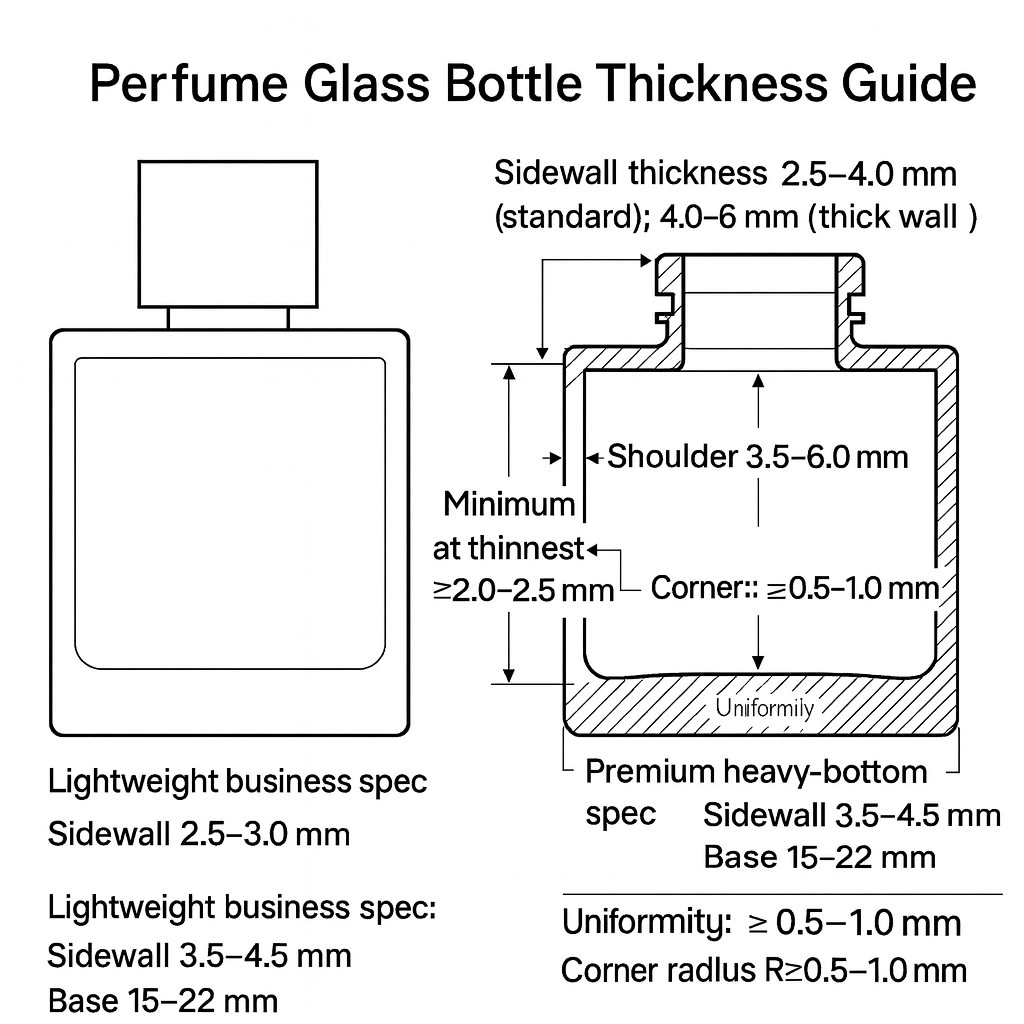
Sidewall
Mass-market: 2.5–4.0 mm
Premium thick-wall: 4.0–6.0 mm
Base
Standard base: 8–15 mm
Heavy/premium base: 12–25 mm
Neck / Shoulder
Shoulder transition: 3.5–6.0 mm
Finish land (e.g., FEA15 crimp or threaded root): 5–8 mm
Small sizes (5–15 ml): sidewall 2–3 mm, base 6–10 mm
Large sizes (>100 ml): sidewall 3–5 mm, base 15–25 mm
Design & Tolerance Tips (Practical)
Minimum thickness at the thinnest point ≥ 2.0 mm
If spray coating / hot stamping / frosting is planned, aim ≥ 2.5 mm to avoid damage during heating or handling.
Thickness ratio (max/min at the same elevation) ≤ 2.5:1 to limit internal stress and bursting risk.
Uniformity control
Within the same height band: wall-thickness delta ≤ 0.5 mm
Between different faces: ≤ 0.7 mm
Base thickness delta ≤ 1.0 mm (premium target ≤ 0.5 mm)
Fillets/radii: Shoulder and base corners R ≥ 0.5–1.0 mm to ease stress.
Critical finish dimensions: Follow the corresponding finish standard, typical tolerance ±0.15–0.30 mm to ensure pump/cap sealing.
How Thickness Affects Product & Cost
Thicker: more solid hand-feel, clearer refraction, better stability.
Trade-offs: higher glass usage and freight, longer forming/annealing, and-if non-uniform-greater burst risk.
Optimization approach: Lower the center of gravity without over-thickening the base-use a thicker base with moderate walls, tightly control the annealing curve and cold-end checks (eccentricity, wall-thickness uniformity, thermal-shock resistance).
Two Typical Setups (50–100 ml)
Lightweight business spec: sidewall 2.5–3.0 mm, base 8–12 mm, total weight ~ 120–180 g.
Premium heavy-bottom spec: sidewall 3.5–4.5 mm, base 15–22 mm, total weight ~ 200–350 g.